 English
 Spanish
 Remote Mower
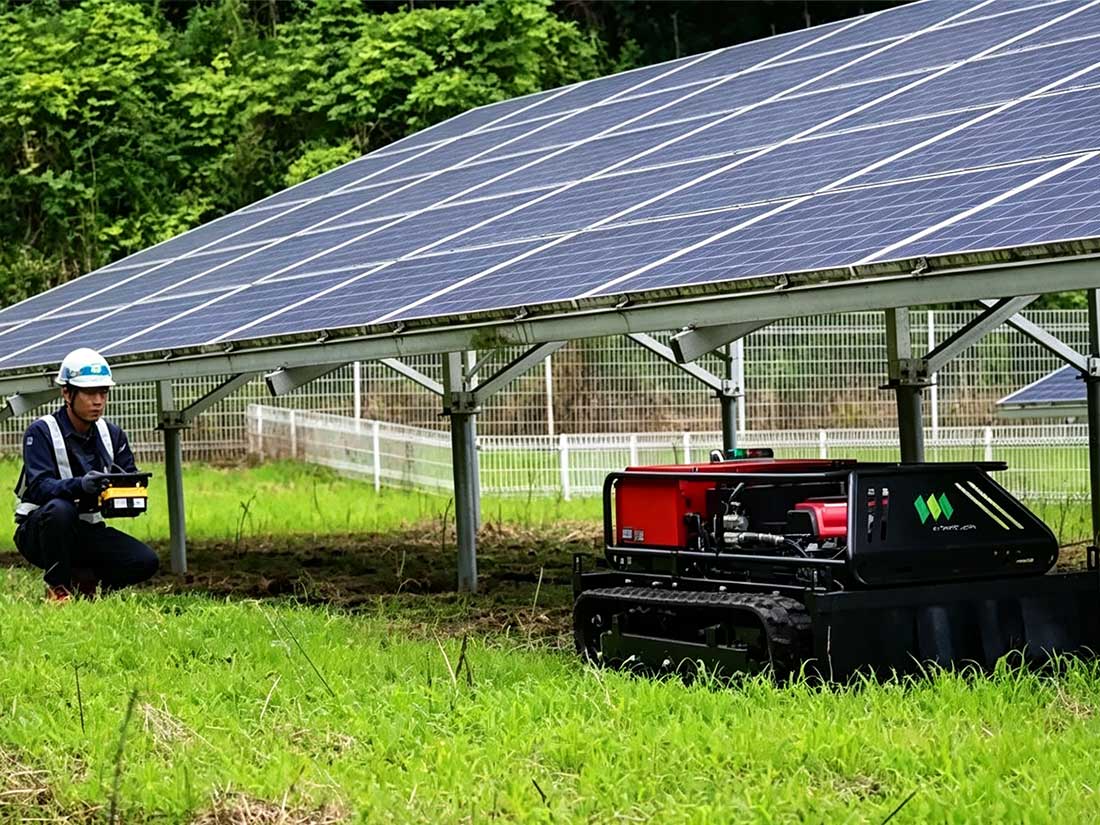
Site Characteristics of Photovoltaic Plants
Photovoltaic areas feature densely arranged solar panel arrays, low support brackets, dense cables, undulating terrain, and gentle slopes/mounds in partial zones. Weeding by manual labor or large agricultural machinery faces prominent limitations. Remote-controlled lawn mowers are perfectly tailored to photovoltaic operation and maintenance scenarios.
I. Safety Advantages (Primary Consideration for PV O&M)
Remote operation with separated operator and machine to avoid multiple hazards
Operators work at safe passages between PV arrays instead of bending to travel underneath solar panels. This prevents injuries from snakes, insects and thorns hidden in weeds, and avoids close contact with brackets and cables to lower risks of accidental touch on live components.
Prevent uncontrolled machine collision with photovoltaic equipment
The machine is equipped with automatic shutdown upon signal loss and emergency stop protection. Compared with walk-behind lawn mowers and backpack brush cutters, its travel route can be controlled more accurately to reduce collisions with PV supports, module frames and combiner boxes.
Avoid damage to solar panels caused by flying stones
The machine can be fitted with guard structures to contain stones thrown by blades and prevent cracking of PV glass panels, greatly cutting maintenance costs for damaged modules (replacement of solar panels incurs extremely high expenses).
II. Site Trafficability, Adapted to PV Plant Environment
Low-profile body enables operation underneath solar panels
Most PV brackets have limited ground clearance at the base, making large ride-on agricultural machinery impassable. Compact, low-height remote-controlled tracked mowers can navigate gaps between arrays and areas under panels to eliminate blind zones for weeding.
Tracked chassis adapts to complex terrain
Mountain and hilly photovoltaic stations contain gentle slopes, uneven bare soil, gravel ground and soft muddy ground after rainfall. Tracks feature low ground pressure to resist slipping and bogging, while wheeled equipment easily slides on slopes or sinks deep into soil.
Flexible steering for easy turning in narrow inter-array passages
PV panels are laid out regularly with narrow passages. Remote-controlled tracked mowers support in-place turning and small-radius maneuvers, suitable for segmented weeding row by row.
III. Protection for Civil Works and Auxiliary Facilities of PV Plants
Preserve ground surface and prevent soil erosion
Tracks exert low ground pressure and will not create deep ruts like tires, protecting covering soil in the plant against erosion. This is especially critical for mountain photovoltaic stations to avoid ponding in grooves that corrodes pile foundations.
Protect PV pile foundations and cables
Adjustable cutting height allows reserved grass stubble. Excessively deep cutting that damages the outer layer of buried cables and disturbs backfill around pile foundations can be avoided. It eliminates common cable breakage faults caused by manual hoeing.
Key Note: Overgrown weeds close to the bottom of PV modules are strictly prohibited. Shading by weeds causes hot spot effect, which may burn solar cells over the long term. Weeding is a vital maintenance procedure to guarantee power generation output.
IV. Advantages in Working Efficiency and O&M Costs
Single-person mechanized operation replaces multiple workers
One remote-controlled lawn mower delivers far higher efficiency than several workers equipped with backpack brush cutters. Large-scale concentrated weeding can be completed rapidly, ideal for centralized mountain photovoltaic stations and agrivoltaic power plants.
Alleviate labor recruitment difficulties
PV plants are usually located in remote outdoor areas, and field weeding involves heavy physical labor with difficulties in hiring workers. Machine replacement reduces long-term labor expenditure and fits regular quarterly weeding maintenance.
Year-round operability
Work can proceed during high-temperature seasons and peak mosquito periods to shorten construction cycles. Weed height can be controlled timely to prevent power generation losses caused by shading.
V. Superior Weeding Technology Compliant with PV O&M Standards
Flail blade design for in-situ mulching
Shredded weeds are spread on the ground on site to suppress germination of new weeds and reduce weeding frequency. The straw mulch retains soil moisture and minimizes soil dust.
Adjustable stubble height
Proper grass roots can be retained instead of fully clearing vegetation to avoid bare ground and dust pollution, meeting environmental protection and soil conservation requirements. It also prevents abnormal ground reflected light from affecting photovoltaic modules.
Capable of bypassing crops (for agrivoltaic projects)
In agrivoltaic parks, the travel path can be precisely controlled to avoid crop zones and realize zoned weeding.