 English
 Spanish
 Portuguese
 French
 Italian
 Remote Mower
Maintaining steep slopes, uneven ground, and dense vegetation can be challenging for landscaping contractors, agricultural operators, and commercial property managers. Traditional mowing equipment performs well on many accessible lawns, but difficult terrain can increase operating risks, require additional labor, and make routine vegetation management more complicated.
A remote controlled lawn mower offers an alternative for these demanding applications. By allowing operators to control mowing equipment from a separate position, remote-controlled machines can help reduce direct exposure to certain terrain-related hazards while improving access to areas that are difficult to maintain with conventional equipment.
This case study explores how a professional landscaping team could evaluate and implement a remote controlled lawn mower for challenging terrain, the operational factors that influence results, and the lessons businesses can apply when selecting remote-controlled mowing equipment.
Case study note: The scenario below is an illustrative industry example, not a verified customer project. Actual results depend on terrain, equipment specifications, vegetation, operating practices, and site conditions.
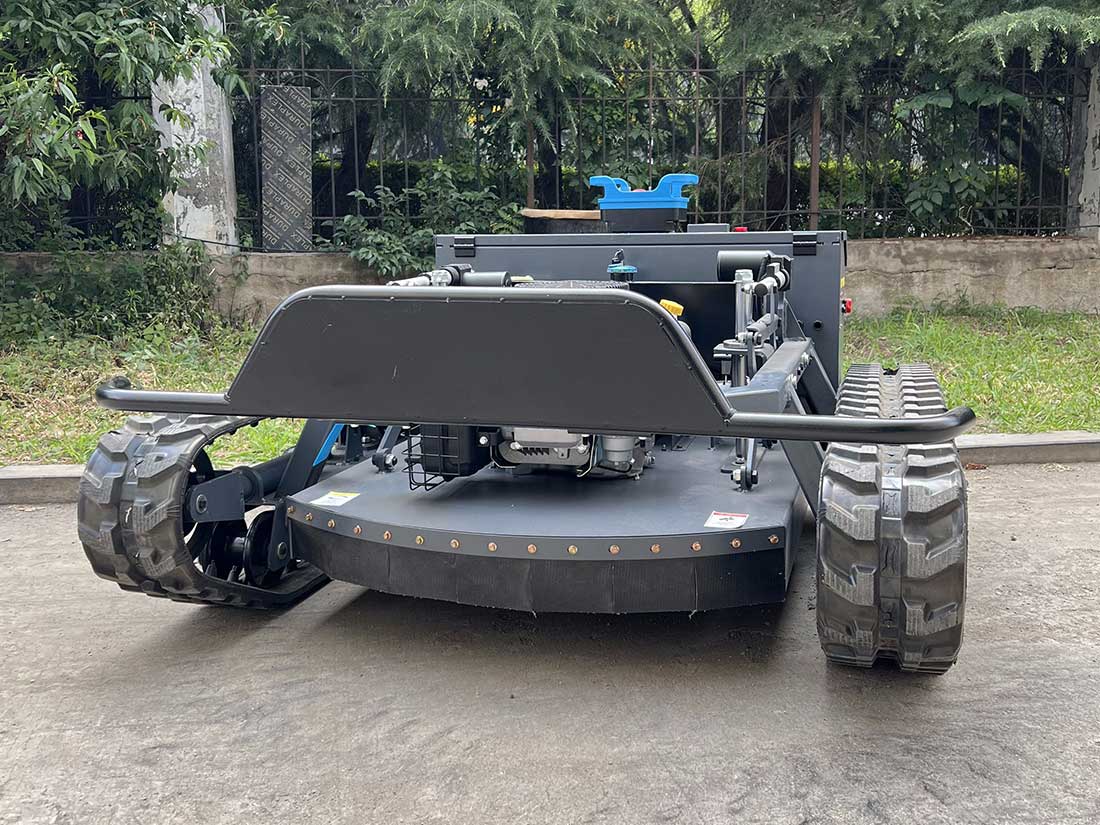
1. The Challenge: Maintaining Difficult Terrain Safely
Imagine a landscaping contractor responsible for maintaining a large commercial property with several distinct areas:
Open lawns surrounding office buildings.
Steep grass-covered embankments along drainage channels.
Uneven ground with scattered rocks and surface irregularities.
Dense grass growing along property boundaries.
Narrow access areas where larger mowing equipment is difficult to maneuver.
The contractor uses conventional mowers for the accessible lawns. However, the embankments and rough sections require additional attention because machine stability, traction, and operator positioning become more important on uneven ground.
Workers must also manage the time required to move equipment between locations and finish areas that conventional mowers cannot easily reach.
The company identifies three priorities: improve the management of difficult terrain, reduce unnecessary exposure to mowing hazards, and maintain consistent vegetation control without increasing operating costs excessively.
After reviewing its existing maintenance process, the contractor considers a remote controlled lawn mower as a specialized addition to its equipment fleet.
2. Evaluating the Remote Controlled Lawn Mower Solution
Rather than replacing every conventional mower, the contractor evaluates whether a remote controlled lawn mower can handle the property's most demanding sections.
This approach reflects a practical principle in professional landscaping: different machines should be assigned to the tasks they are designed to perform.
A remote-controlled mower can be especially useful when the terrain, vegetation, or access conditions make conventional mowing more difficult. However, the selected machine must match the actual working environment.
The contractor reviews several important specifications before making a decision.
Slope capability and machine stability
The steepest sections of the property must be measured and compared with the manufacturer's permitted operating limits.
The contractor also considers cross-slope operation, ground conditions, traction, and whether wet grass or loose soil could affect machine stability.
A remote controlled lawn mower is not automatically suitable for every incline. Its documented slope rating and operating instructions must govern where and how it is used.
Track design and ground contact
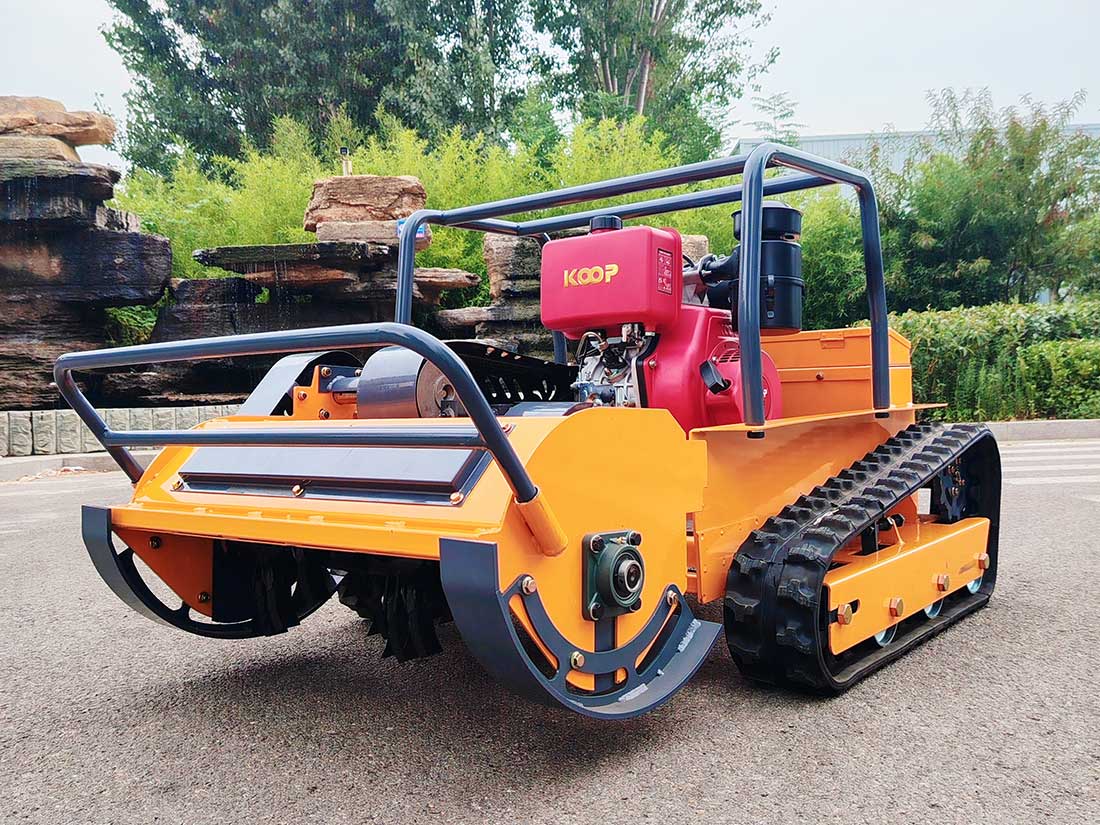
A tracked remote controlled lawn mower may provide useful traction on certain uneven surfaces because its tracks distribute machine weight across a broader contact area.
However, performance depends on track design, soil conditions, weight distribution, and slope angle. Tracks do not eliminate the risk of slipping or loss of stability.
Cutting system
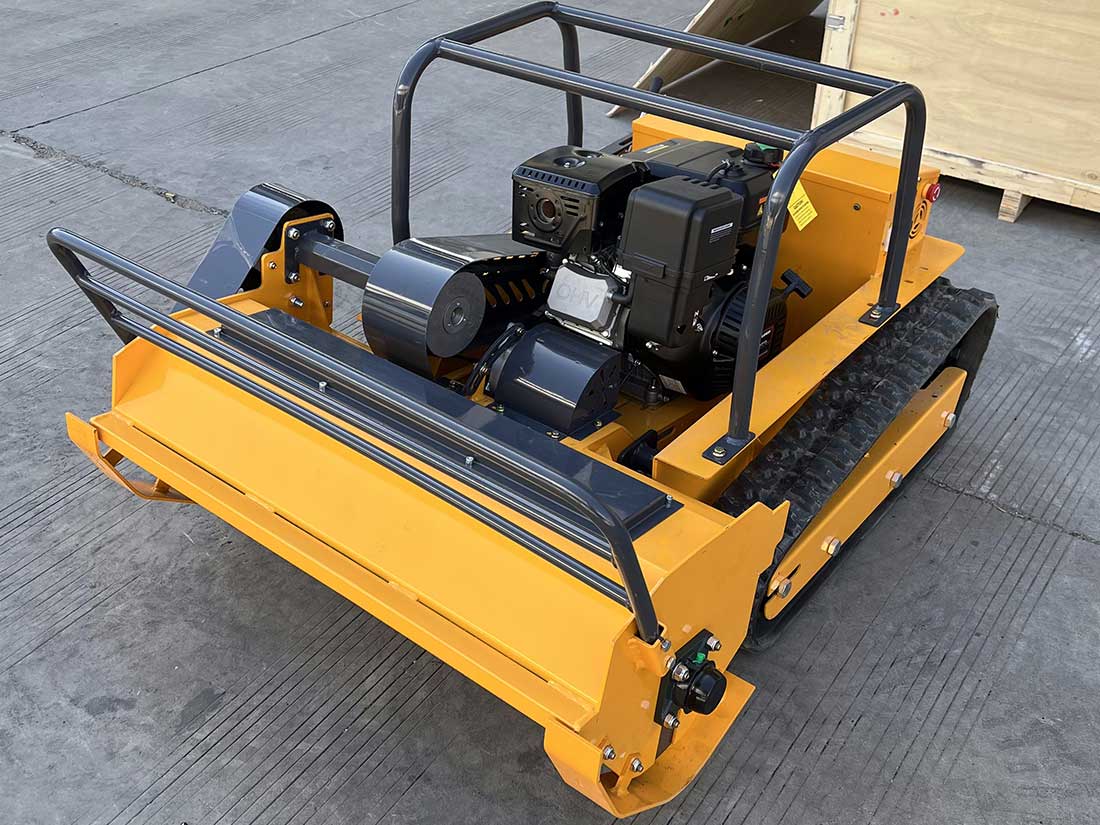
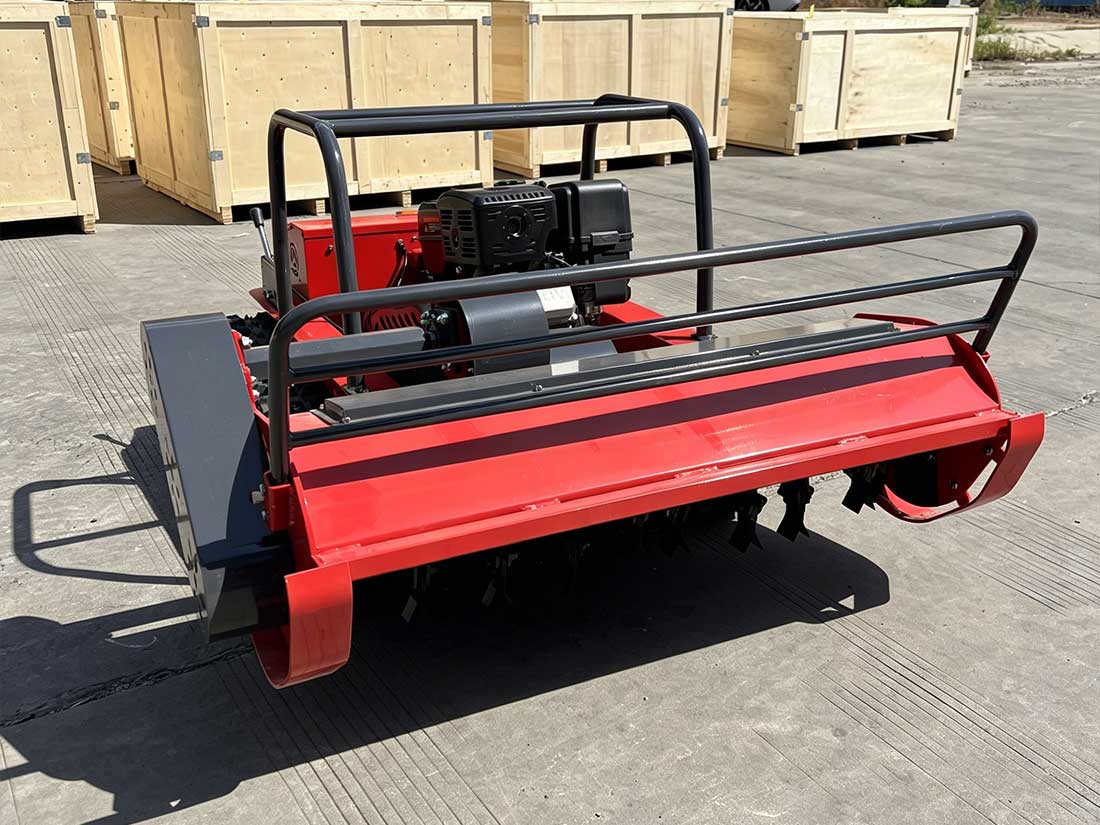
The property contains both regularly maintained grass and rough vegetation. The contractor therefore evaluates whether a rotary cutting system or a flail mower is better suited to each section.
Rotary systems can be appropriate for routine grass cutting, while suitable flail systems may be preferable for rough grass and selected dense vegetation.
The choice depends on the machine's specified cutting capacity and the type of vegetation encountered.
Remote-control and safety functions
The contractor checks the operating range, emergency-stop functions, control responsiveness, communication-loss behavior, and visibility of the machine during operation.
These details are important because remote operation changes the operator's position but does not eliminate hazards from moving blades, thrown debris, unstable ground, or nearby people.
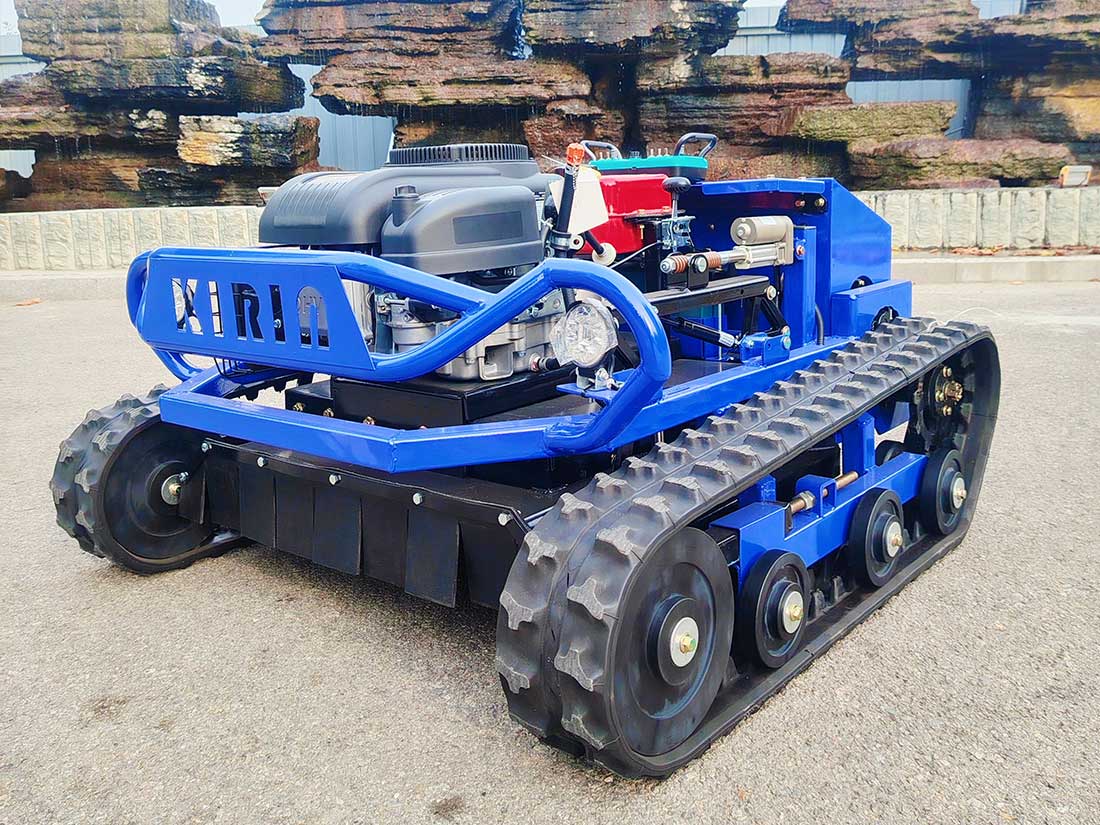
3. Implementing the Remote-Controlled Mowing Strategy
After identifying a suitable machine configuration, the contractor develops a maintenance plan that combines remote-controlled and conventional mowing equipment.
The work is divided into three operating zones.
Zone 1: Flat, accessible lawns
Conventional mowing equipment continues to handle large, open areas where it is already efficient and economical. This avoids using specialized equipment for tasks that do not require its capabilities.
Zone 2: Slopes and embankments
A suitably rated remote controlled lawn mower is assigned to designated slope-maintenance areas. Operators follow approved slope limits, establish safe working zones, and maintain visibility of the machine.
Zone 3: Rough vegetation and restricted areas
The team uses equipment selected for the vegetation density and access conditions. A remote-controlled machine is deployed only where its dimensions, cutting system, and operating specifications are appropriate.
This strategy helps the contractor avoid treating every mowing task in the same way. It also creates a clear framework for evaluating where a remote controlled lawn mower adds value and where traditional equipment remains the better choice.
4. How Remote-Controlled Equipment Can Improve Safety
Safety is one of the most important reasons to evaluate remote-controlled mowing equipment for challenging terrain.
When a worker operates a conventional mower, the operator's position is tied more closely to the machine. On steep ground, this may expose the worker to hazards associated with walking on an incline or operating equipment from an onboard position.
A remote controlled lawn mower allows the operator to guide the machine from a separate location. On suitable terrain, this can reduce the need to stand directly on the slope or ride on the machine.
Potential safety benefits include:
Improved operator positioning: The operator can choose a suitable control position while maintaining a clear view of the work area.
Reduced direct exposure to slopes: Certain tasks can be completed without requiring the operator to walk directly behind the mower on difficult ground.
Remote stopping capability: Models equipped with emergency-stop functions can provide an additional layer of operational control.
More structured work procedures: Teams can establish designated operating zones and consistent inspection routines.
These advantages must be supported by proper training and site management. Before mowing begins, the operator should inspect the terrain, identify obstacles, check the machine, and confirm that the working area is clear of unauthorized people.
The contractor should also establish procedures for communication loss, emergency shutdown, debris hazards, and safe machine recovery.
A remote controlled lawn mower should never be operated beyond its rated limits or used as a substitute for a comprehensive site safety plan.
5. Measuring Productivity and Operational Efficiency
The contractor's next objective is to determine whether remote-controlled equipment improves the efficiency of difficult-terrain maintenance.
Rather than relying on assumptions, the company compares operating performance before and after introducing the machine.
Useful performance indicators include:
Performance indicator | What it measures |
|---|---|
Labor hours per mowing task | The total labor required to complete the assigned area |
Area maintained per hour | The amount of ground covered under actual working conditions |
Setup and transport time | The time needed to position and prepare equipment |
Manual trimming requirements | The amount of work still requiring handheld tools |
Maintenance downtime | Time lost to servicing, repairs, or equipment issues |
Operating cost per area | Fuel or electricity, labor, maintenance, and other relevant costs |
For example, if a remote controlled lawn mower reduces the time required to maintain a particular embankment, the contractor can calculate the potential labor savings across repeated maintenance cycles.
However, the results may vary considerably. Steepness, grass density, cutting width, travel speed, obstacles, and operator experience all affect productivity.
A remote controlled lawn mower may also require additional setup or transport time compared with a conventional mower. These factors should be included in any fair comparison.
The most useful assessment measures total task completion time and cost rather than focusing solely on the machine's cutting speed.
6. Financial Considerations: Is a Remote Controlled Lawn Mower Worth the Investment?
Specialized mowing equipment requires an upfront investment, so contractors should evaluate its financial value before purchasing.
The first step is to identify how frequently the company encounters difficult terrain and how much it currently spends maintaining those areas.
Relevant costs include:
Labor for mowing and manual trimming.
Fuel or electricity consumption.
Equipment maintenance and replacement parts.
Transport and setup requirements.
Downtime and repair expenses.
Training and operating procedures.
A remote controlled lawn mower may be a sensible investment when difficult-terrain jobs are frequent enough to justify the equipment and when the machine can reduce measurable costs or improve the company's ability to complete work safely.
For occasional projects, renting specialized equipment or subcontracting the work may be more economical.
A simple return-on-investment calculation
A contractor can estimate annual net savings using the following approach:
The estimated payback period can then be calculated as:
These calculations should use realistic figures based on the contractor's own jobs. If annual net savings are zero or negative, the investment will not pay back through operating savings alone.
This method helps businesses evaluate a remote controlled lawn mower based on measurable financial performance rather than general marketing claims.
7. Lessons for Professional Landscaping Teams
The illustrative case highlights several useful lessons for companies considering remote-controlled mowing equipment.
Match equipment to the terrain
Not every remote controlled lawn mower is designed for steep slopes or dense vegetation. Verify the machine's specifications against the site's actual conditions.
Keep conventional equipment where it performs best
Traditional mowers remain effective for many flat, accessible lawns. Using a mixed fleet can be more practical than replacing all existing equipment.
Prioritize safety systems and operator training
Remote operation changes where the operator stands, but hazards remain. Training, site inspections, emergency procedures, and compliance with manufacturer instructions are essential.
Measure actual performance
Record labor hours, mowing coverage, setup time, maintenance, and operating costs. These figures help determine whether the equipment is delivering meaningful improvements.
Evaluate supplier support
Parts availability, service documentation, warranty conditions, and technical assistance can influence long-term equipment reliability.
By following these principles, contractors can make more informed decisions about whether a remote controlled lawn mower is appropriate for their maintenance operations.
8. Explore Remote-Controlled Mowing Equipment from JUYOU
Businesses looking for equipment to manage slopes, embankments, rough vegetation, and other challenging mowing environments can explore the options available from JUYOU Lawn Mower.
When evaluating a remote controlled lawn mower for professional use, buyers should compare the specifications of individual models rather than relying on general product descriptions alone.
Consider the following questions when discussing your requirements with a supplier:
What is the maximum permitted operating slope?
Is a tracked or wheeled configuration more suitable for the site?
Which cutting system is recommended for the vegetation?
What are the machine's cutting width and power specifications?
Which safety functions are included?
What maintenance, spare parts, and after-sales support are available?
Preparing this information can help narrow the available options and make the purchasing process more efficient.
Visit https://www.jylawnmower.com/ to explore remote-controlled mowing equipment and identify potential solutions for your landscaping or vegetation-management requirements.
9. The Future of Remote-Controlled Mowing Equipment
As landscaping businesses look for ways to manage difficult terrain more effectively, remote-controlled mowing technology is likely to remain an important equipment category.
Potential developments include improved control systems, enhanced safety monitoring, more efficient power configurations, and cutting systems designed for specific vegetation-management applications.
For professional buyers, the value of these innovations depends on their performance in real working environments. Reliable operation, practical maintenance requirements, operator training, and documented safety limits remain essential.
A remote controlled lawn mower is best viewed as a specialized tool within a broader vegetation-management strategy. Its greatest value may come from complementing conventional equipment rather than replacing every traditional mowing method.
Conclusion
This illustrative case study demonstrates how a remote controlled lawn mower could help a landscaping contractor approach steep slopes, uneven ground, and difficult vegetation with a more specialized maintenance strategy.
Potential benefits include improved operator positioning, greater flexibility in equipment deployment, and more efficient management of certain difficult-to-access areas. However, the actual results depend on machine suitability, terrain conditions, operator training, maintenance, and project costs.
For businesses considering remote-controlled mowing equipment, the best approach is to define the operational challenge, compare suitable machines, and measure performance under realistic conditions.
If your landscaping projects involve steep embankments, rough ground, or demanding vegetation-management tasks, explore the available options at JUYOU Lawn Mower to learn more about remote-controlled mowing solutions for professional applications.